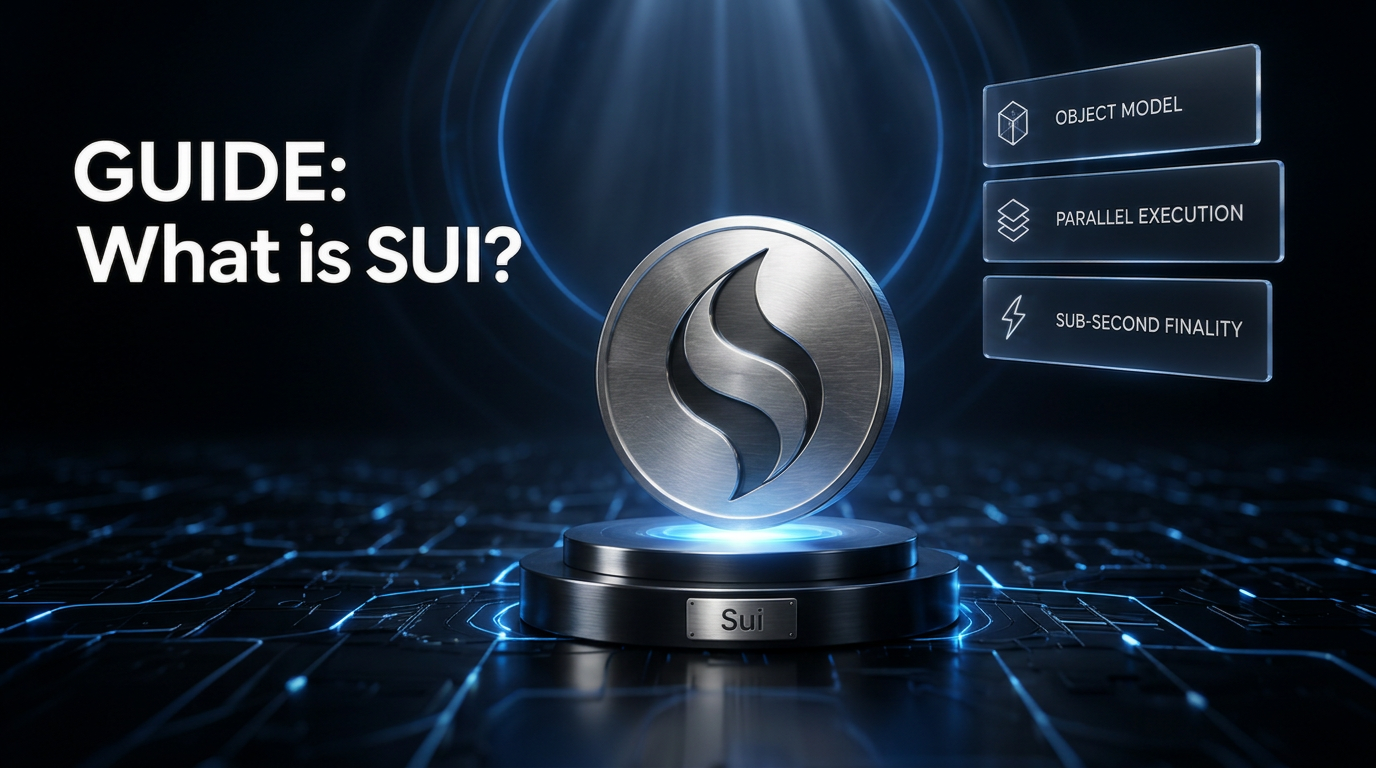
GUIDE: What is Sui?
Sui is a Layer 1 blockchain where each asset is stored as its own object in the owner's wallet, rather than as a line in a shared ledger. This design allows operations that do not interfere with each other to be processed simultaneously. Here we explain who built it, how it works internally, what the SUI token is for, and which risks you should keep in mind before investing.
CoinGecko
The origin: the team that left Meta
Sui is developed by Mysten Labs, a company founded in November 2021 by four engineers who had worked together at Novi, the subsidiary through which Meta attempted to launch its own digital currency. They are Evan Cheng, who previously spent a decade at Apple and led research at Novi; Sam Blackshear, lead author of the language used to program Sui contracts; Adeniyi Abiodun, who led the project's product side; and George Danezis, a cryptographer and professor who was a researcher on the same team.
That language is called Move and was born within the Libra project —later renamed Diem—, as explained by Meta itself in its 2019 technical paper. Move is designed so that assets behave like resources that cannot be duplicated or double-spent: the rules of use are part of the language itself rather than a standalone contract. Sui uses an adaptation known as Sui Move.
Meta's attempt failed due to pressure from regulators, who halted the project in January 2022, but the team did not consider the technology lost. Months earlier, they had already set up Mysten Labs to continue on their own with a proprietary design: instead of a payment currency, a general network where any developer could publish applications.
The Sui mainnet went live on May 3, 2023, after a year of testing. Development is coordinated today by Mysten Labs, while the funding for audits, grants, and ecosystem programs is handled by the Sui Foundation, an entity registered in the Cayman Islands according to documentation filed with the US Securities and Exchange Commission.
How Sui works internally
The central difference lies in where the information lives. In most chains, the state of the network is a giant ledger that all validators update order by order, so any operation requires consulting that ledger. In Sui, assets are objects that belong to an address and travel with it: the network does not need to check a global state to know if someone can spend what they have, because the object itself carries its owner and its history inscribed.
This leads to a practical advantage: operations that do not compete for the same object can be processed simultaneously. If two users send coins to different wallets, there is no reason to put them in a queue. Sui groups these independent transactions and executes them in parallel, reserving strict coordination for cases where two operations do overlap, such as when both want to buy the same asset.
To agree on the order of operations that do depend on each other, Sui uses Mysticeti, a proprietary consensus system based on a message graph instead of sequential blocks: validators propose, and a majority exceeding two-thirds of the voting power approves. Transfers between objects of a single owner can shorten this path and, under normal conditions, are confirmed in less than a second with fees of fractions of a cent.
The network is sustained by validators who lock SUI as collateral, and any holder can delegate their coins to one of them without giving up custody and take a share of the rewards. These rewards come from fees and an emission fund reserved for this purpose, about 950 million SUI to be distributed over several years: the network is not deflationary, and this emission is part of the real cost of keeping it secure.
Ecosystem, SUI token and risks
The SUI token is used to pay fees, for staking that secures the network, to vote on protocol governance decisions, and as a liquid asset within applications. The maximum supply is 10 billion units, but at the mainnet launch, only around 5% was circulating: the rest was allocated to the ecosystem, the team, and early investors, with long release schedules. Independent unlock trackers point out that the largest individual recipient, who has not been publicly identified, controls more than half of the maximum supply and cannot sell it until after 2030.
Decentralized finance has been the primary focus of development on the network: markets like Cetus or Turbos, lending platforms like Scallop, and a native order book, DeepBook, which has been operating since July 2023. Circle has been issuing USDC natively on Sui since October 2024, making it the first Move-based chain with digital dollars direct from the issuer, and in 2026, Sui Dollar joined, a stablecoin issued by Bridge, the payments company acquired by Stripe.
Institutional interest has also arrived. In February 2026, the 21Shares fund (TSUI) and the Canary staking fund (SUIS) were listed in the United States, both on Nasdaq, and Grayscale obtained certification to list its Sui staking ETF on NYSE Arca. On the platform side, Kraken has offered SUI staking since July 2025, while Coinbase does not support it in its retail app, though it does in its institutional service: if you want to collect rewards, check how each exchange handles it first.
The network has not been free of failures. On November 21, 2024, the mainnet stopped for about two and a half hours because all validators entered a reboot loop due to an error in the congestion control code; it was fixed with an emergency patch and the foundation published the incident analysis. Before launch, two bugs that could have brought down the network were found and fixed thanks to bug bounty programs. These are signs of a technology that is still young: it competes with much older chains, its price is highly volatile, and scheduled coin unlocks can weigh on it even if the network continues to grow. Invest only what you can afford to lose and keep significant balances in your own wallet.
You can buy SUI on MiCA-licensed platforms. Compare fees, security, and payment methods in our independent ranking.
Buy SUI on a licensed exchangeResources
- Sui official technical documentation (architecture and consensus)
- Official SUI supply schedule
- Mainnet launch press release (May 3, 2023)
- Official analysis of the November 2024 network outage
- Circle: native USDC on Sui
- Nasdaq: listing of the 21Shares fund on Sui
- Nasdaq: listing of the Canary staking fund on Sui
- Independent SUI unlock tracking (Blockworks)