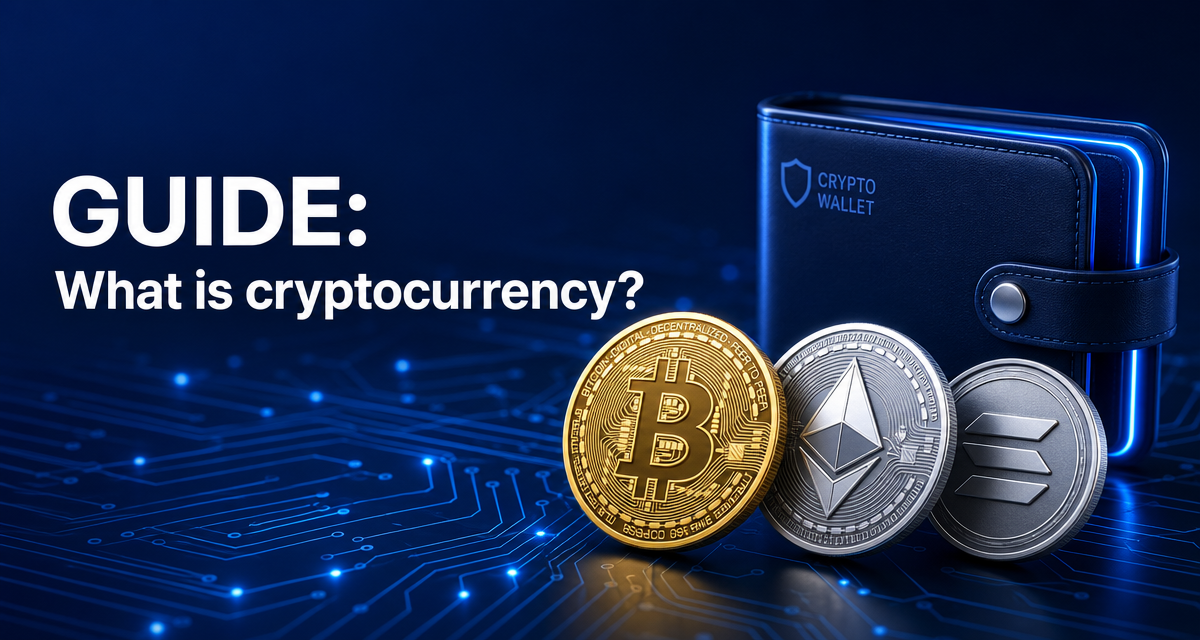
GUIDE: What is a cryptocurrency?
A cryptocurrency is digital money that operates without banks or intermediaries, thanks to a network of computers that verify each transaction using cryptography. It sounds simple, but behind it are concepts that should be understood before investing a single euro. This guide explains them all, from scratch.
The definition, without jargon
A cryptocurrency is a unit of value that exists solely as an entry in a shared digital ledger. This ledger, the blockchain, is not kept by a single company: it is maintained by thousands of computers distributed worldwide, and all have the same copy.
When you send cryptocurrencies, you don't move a file. You digitally sign a message that says 'subtract this amount from my address and add it to this other one.' The network verifies that the signature is valid and that you have sufficient balance, then updates the ledger. Nobody can forge that signature without your private key, and nobody can delete the operation once confirmed.
The difference with your bank's money is who keeps the accounts. In the traditional system, the bank maintains the ledger and can block, reverse, or freeze a transfer. In a cryptocurrency, the ledger is public, and the rules are enforced by software, not a person.
How it works internally: keys, addresses, and blocks
It all starts with a pair of keys. The private key is a secret number only you know; the public key is derived from it and generates your address, which you can share without risk. Whoever has the private key controls the funds: that's why the twelve- or twenty-four-word recovery phrase that a wallet shows you when you create it is literally your money.
Transactions are grouped into blocks. Each block includes a cryptographic hash of the previous one, so modifying an old operation would require redoing all subsequent blocks on all computers in the network simultaneously. That's what makes the history practically immutable.
To decide who adds the next block, there are two main mechanisms. Proof-of-Work, used by Bitcoin, requires expending electricity to solve a mathematical problem: whoever solves it first proposes the block and receives a reward. Proof-of-Stake, used by Ethereum since 2022, requires locking up coins as collateral: validators who act maliciously lose part of that deposit. Both systems aim for the same thing: to make attacking the network more expensive than respecting it.
Each transaction pays a fee that adjusts according to demand. When the network is congested, fees go up; when it's quiet, they go down. On fast or second-layer networks, they can be mere cents.
Types of crypto assets that exist
Not everything called a cryptocurrency is the same. Bitcoin is the first and largest, designed as scarce money with a limit of 21 million units. So-called smart contract platforms, like Ethereum or Solana, are networks on which applications are built: their currency primarily serves to pay for network usage.
Stablecoins are tokens whose value is pegged to a traditional currency, usually the euro or dollar, and backed by reserves. They are used to move money quickly between platforms and to seek refuge from volatility without leaving the market. In the European Union, MiCA requires their issuers to maintain audited reserves and to be authorized.
Then there are utility tokens, which provide access to a specific service; governance tokens, which grant voting rights in protocol decisions; non-fungible tokens or NFTs, which represent a unique object; and tokenized assets, which represent real-world bonds, funds, or real estate. And, unfortunately, there are also tokens with no project behind them, created solely for speculation.
A practical rule of thumb: the less clear it is where a token's value comes from —who uses it, for what, and why someone would pay for it five years from now— the greater the risk of losing everything.
Where they are stored: wallets and custody
There are two ways to hold cryptocurrencies. In custody, when an exchange holds them for you: it's convenient, allows access recovery if you forget your password, and in Europe, it's subject to regulations requiring the separation of your funds from the company's. The downside is that you depend on that company.
In self-custody, you control the keys. This can be a software wallet on your mobile or computer, convenient for small amounts and daily use, or a hardware wallet, a physical device that signs transactions without ever exposing the private key to the internet. This is the recommended option for long-term savings.
With self-custody, there's no customer service. If you lose your recovery phrase, you lose your funds; if someone sees it, they take them. Write it down on paper or metal, store it in two different physical locations, never photograph it or write it on your phone, and be wary of anyone who asks for it: no legitimate technical support will ever do so.
Real risks and most common scams
The first risk is price. Cryptocurrencies are volatile, and drops of 50% or more are a normal part of their history. Only invest money you can afford to lose and avoid leverage if you're just starting out.
The second is operational: sending to the wrong address, using an incorrect network, or signing a malicious permission. These operations are irreversible. Always make a small test transfer first and check the full address, not just the first few characters.
The third is fraud. The most common scams are fake investment platforms with guaranteed returns, romance scams that end in a fake trading app, supposed giveaways from celebrities, fake technical support on social media, and cloned pages that imitate a real exchange. General rule: nobody gives away money, no investment guarantees profits, and any rush is a red flag.
The fourth is regulatory and tax-related. Operating on unlicensed platforms leaves you without practical protection, and not declaring your transactions can result in penalties.
Regulation, taxes, and sensible first steps
Since 2024, MiCA regulates issuers of stablecoins and providers of exchange and custody services across the entire European Union. Platforms need a license from a national supervisor, must segregate client funds, publish real fees, and offer a formal complaint channel. Checking that your platform is licensed is the simplest and most effective filter you can apply.
Regarding taxes, the general rule in Europe is that selling cryptocurrencies, exchanging one for another, or paying with them generates a capital gain or loss that is subject to income tax in your country, even if you don't convert to traditional currency. Rewards from staking, mining, or airdrops are also taxable. Keeping a record with the date, asset, quantity, and value in euros of each transaction will save you many problems.
If you're starting, a reasonable plan would be this: dedicate a few hours to understanding what you're buying before buying it; choose a MiCA-licensed platform and enable two-factor authentication; start with a small amount and, if you want to reduce the effect of volatility, buy periodically instead of all at once; try withdrawing a symbolic amount to your own wallet before moving serious amounts; and store your recovery phrase as you would your house deeds.
And above all, distrust urgency. The crypto market has been operating for over fifteen years and will still be here next week. No legitimate opportunity demands that you decide in five minutes.
The three cryptocurrencies worth understanding first
Before looking at small projects, it's worth thoroughly understanding the three networks that concentrate most of the market activity. Each solves a different problem and serves as a reference point for judging any other project.
Bitcoin is the starting point: the first cryptocurrency, born in 2009, with a limited issuance of 21 million units and a network secured by proof-of-work. It is the most well-known, most liquid asset, and the one that sets the pace for the entire market. In our guide on the history of Bitcoin, we review its origin, Satoshi Nakamoto, and the dates that made it what it is today.
Ethereum added smart contracts: self-executing programs on the blockchain that have made stablecoins, lending markets, and practically all decentralized applications possible. Its guide tells the story from 2013 and includes the real-time price of ETH.
Solana is the fast and cheap alternative: a network designed to process thousands of transactions per second with fees of mere cents, widely used in payments, decentralized exchanges, and consumer applications. In its guide, we explain how it works, its history, and the live price of SOL.
The three guides are linked below and are the best way to move from general theory to understanding specific projects.
Once you're clear, our practical guide will walk you step-by-step through your first purchase on a licensed platform.
How to Buy Your First Cryptocurrency