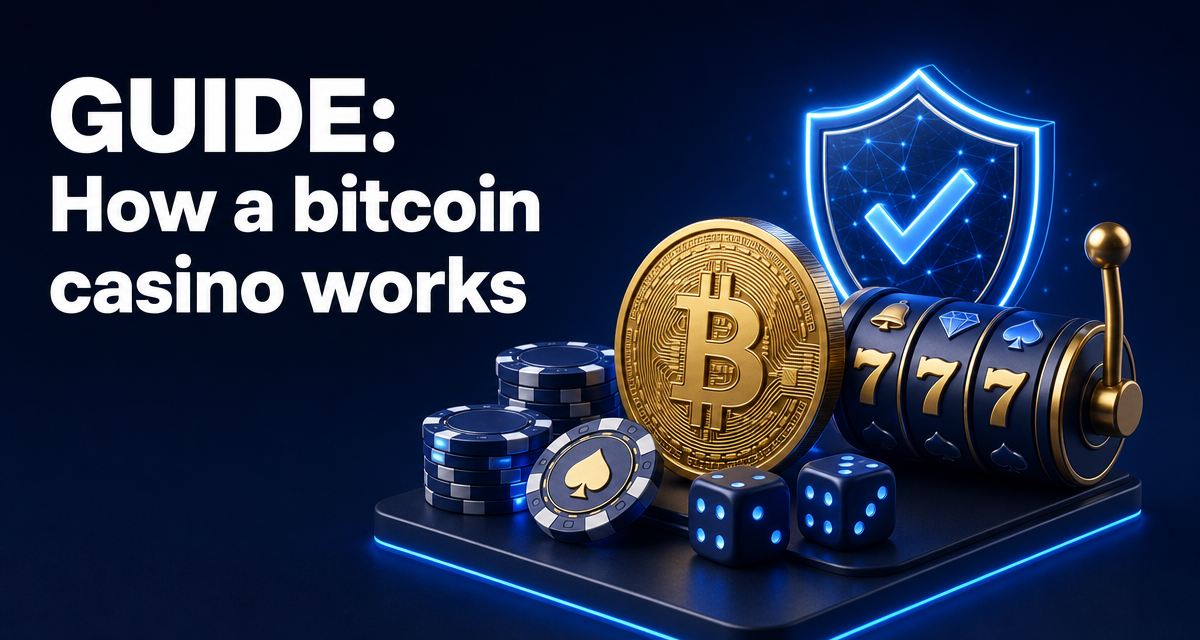
GUIDE: How does a Bitcoin casino work?
A Bitcoin casino works like any online casino, with one key difference: money enters and exits in cryptocurrencies. This changes speed, fees, and, in some cases, how the fairness of games is verified.
Crypto deposits and withdrawals
Upon registration, the casino assigns you a deposit address. You send Bitcoin from your wallet or exchange, and the balance appears in your account once the network confirms the transaction, usually within minutes. Many casinos also accept fast and cheap networks like Lightning, Tron, or Solana for small amounts.
Withdrawals work the same way in reverse: you provide your address, and the casino sends the funds. This is the most cited advantage over traditional banking: no bank transfers taking days, nor cards rejecting payments. Serious casinos process withdrawals in under an hour.
Some operators convert your deposit to euros or dollars internally so your balance doesn't fluctuate while you play; others keep the balance in Bitcoin. It's advisable to know which model the platform uses before depositing a large amount.
What "provably fair" means
In a traditional casino, you trust that the random number generator is correct because an auditor has certified it. Crypto casinos add a system called "provably fair" that allows you to verify it yourself.
It works like this: before the play, the casino publishes a cryptographic hash of its secret seed. You contribute your own seed. The result is calculated by combining both. After the game, the casino reveals its seed, and you can verify that the hash matches and that the result was not altered afterward.
Not all games support it: it's usually available in proprietary games (dice, crash, mines, simple roulette) and not in third-party provider slots, which are still audited by independent labs.
Licenses, verification, and limits
The license determines your protection. Curaçao is the most common in the crypto sector and the most lenient; Malta, the Isle of Man, or national authorities like the Spanish one impose much stricter requirements regarding client funds, advertising, and responsible gaming.
Many crypto casinos allow playing with little verification, but they usually request documentation when withdrawing high amounts or when anti-money laundering alerts are triggered. This is normal and legal: review the verification policy before depositing, not after winning.
Remember also that gambling winnings are taxed according to the rules of your country of residence, regardless of whether they are collected in cryptocurrencies.
Bonuses and responsible gambling
Welcome bonuses and cashback are the main attraction, but the important part is the wagering requirement: a €100 bonus with a 40x rollover means you have to bet €4,000 before you can withdraw. Always compare this number, the contribution of each game, and the maximum withdrawal limit for the bonus.
RTP (return to player) indicates the percentage a game returns in the long run. 96% means the house edge is 4%: in the long run, the house always wins. Play only with money you can afford to lose, use deposit limits and self-exclusion options, and treat gambling as entertainment, not an investment.
Security, taxes, and common new player mistakes
Playing with cryptocurrencies adds a layer of responsibility that doesn't exist in a traditional casino: here you control the money, and there's no bank that can reverse a transfer. The first piece of advice is never to use the wallet where you keep your long-term savings. Create a separate wallet with a limited balance, and only move what's necessary for playing. Activate two-step verification on your casino account, use a unique password, and be wary of any message or email asking you to log in from a link: casino page spoofing is one of the most frequent scams in the industry.
Before your first deposit, also check the network you're using. Sending funds via the wrong network or to an address for a different asset usually means losing them forever. Make a small initial transfer to confirm everything arrives correctly, and save proof of every transaction. And review withdrawal conditions before depositing, not after: some operators require identity verification only upon withdrawal, which can delay payment for several days if you don't have your documentation ready.
Taxation is the most overlooked aspect. In most European countries, gambling winnings are taxable and must be declared according to the rules of your country of residence. Additionally, every movement between cryptocurrencies and euros can generate a capital gain or loss due to exchange rate variations. This means you can have two distinct tax events in a single session. Keeping a simple record with the date, amount, asset, and euro value of each deposit and withdrawal will save you a lot of work when preparing your tax return. If the amounts are significant, consult a specialized advisor.
Among the most common mistakes are chasing losses by increasing bets, accepting a bonus without reading the wagering requirements, playing on an unlicensed operator because it offers more generous bonuses, and confusing volatility with luck: if your balance goes up because Bitcoin has risen, it doesn't mean you're winning at the game. Set a budget and a maximum session time in advance, activate the deposit limits offered by the platform itself, and use self-exclusion if you feel you're losing control. A casino is entertainment with an expected cost; treating it as a form of investment is the quickest way to lose money and peace of mind.
We have analyzed licenses, fees, withdrawal speed, and bonuses in our Bitcoin casino comparison.
See best Bitcoin casinos