Satoshi Nakamoto: the creator of Bitcoin
One person, or perhaps a small group, created a digital money that works without a central bank. We know them as Satoshi Nakamoto. Their invention is public; their identity is not. This is the story of how Bitcoin was born and the best-known theories about who is behind the name.
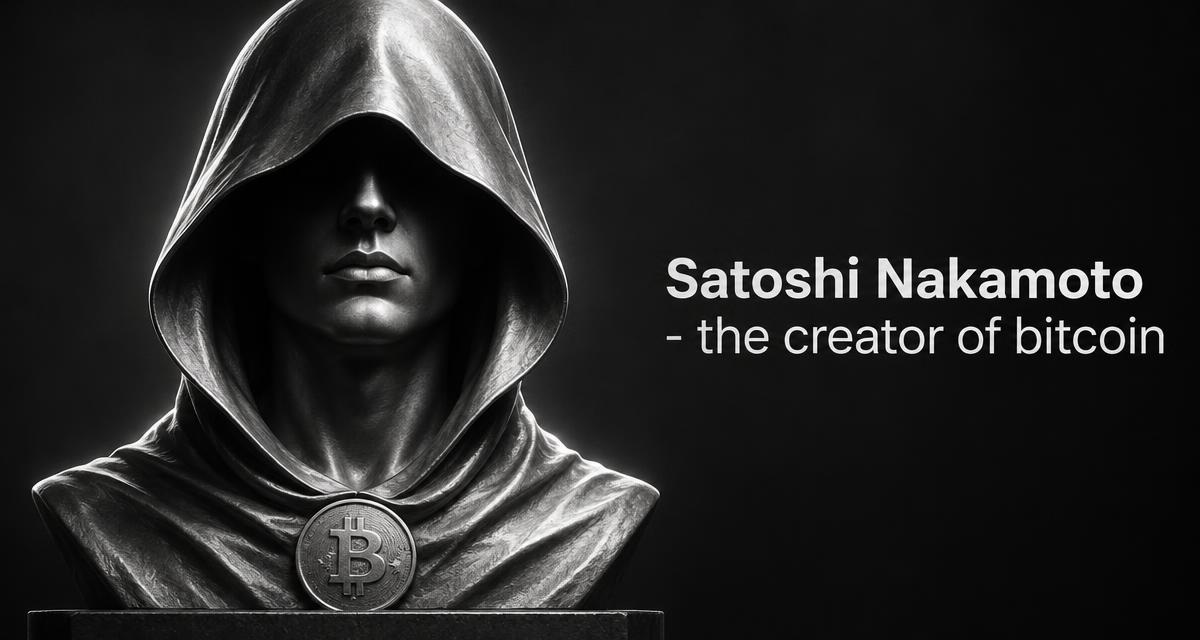
Artistic representation of Satoshi Nakamoto, not a verified portrait. Their identity remains unconfirmed; the photograph of Dorian Nakamoto that often circulates does not prove that he created Bitcoin.
What do we really know about Satoshi?
Satoshi Nakamoto is the pseudonym used by whoever presented Bitcoin, wrote its first version and collaborated with the network's first participants. We know their messages, their whitepaper and the code they published. There is no verified public identification of the person or persons behind the name.
The name sounds Japanese, but that does not prove nationality, age or gender. We also do not know if Satoshi worked alone. Separating these facts from assumptions is important: a stylistic coincidence, a popular photograph or a claim on television does not solve the mystery.
Before Bitcoin: a pending problem
For years, researchers tried to create money for the internet. The main obstacle was double-spending: if a digital file can be copied, how do you prevent someone from spending the same coin twice? A bank can keep a record and decide which payment is valid, but then everyone depends on that bank.
Satoshi combined previous ideas —digital signatures, linked records and proof of work— into a system that allows agreeing on a shared history without a central administrator. The whitepaper cites Hashcash, by Adam Back, and b-money, by Wei Dai. Bitcoin did not appear out of nowhere: it was a new combination of decades of cryptographic research.
October 31, 2008: the whitepaper
On October 31, 2008, Satoshi announced the document "Bitcoin: A Peer-to-Peer Electronic Cash System" on a cryptography mailing list. In nine pages, it explained how to send payments directly between people, without going through a financial institution.
The proposal arrived during the global financial crisis. That context helps to understand the interest in alternatives to the banking system, but it does not prove all of Satoshi's personal motives. Their specific contribution was describing a mechanism for independent participants to verify transactions and accept the same blockchain.
In simple terms: instead of asking a bank for permission, each participant can verify the rules. Miners group transactions and provide proof of work; nodes check that the blocks comply with the rules. Having more mining power does not allow the creation of invalid coins that nodes must accept.
January 2009: Bitcoin starts running
On January 3, 2009, Satoshi created the genesis block, the first Bitcoin block. It included the headline "The Times 03/Jan/2009 Chancellor on brink of second bailout for banks", regarding a possible second British bank bailout. The text places the block in its era and is often interpreted as a commentary on the financial system; the exact intention cannot be proven.
On January 8, the first public version of the software, Bitcoin v0.1, was announced. It was no longer just an idea in a document: other people could download the program, review the code, and participate in the network.
On January 12, 2009, Satoshi sent 10 BTC to Hal Finney. The transaction, included in block 170, is the first known transfer between two participants. In those days, the major current exchanges and a consolidated market price did not exist: it was an experiment that a few people were testing.
2010–2011: Collaborating and then stepping back
Satoshi answered questions, fixed bugs, and discussed improvements with early developers. During 2010, others took on more and more work. Gavin Andresen became one of the main leads for development, and Satoshi gradually stopped directing the project.
His last known post on the BitcoinTalk forum dates back to December 12, 2010. A few private emails followed. In an email to Mike Hearn on April 23, 2011, he wrote that he had moved on to "other things" and that the project was in good hands.
We do not know why he stepped back. Privacy, personal security, and the desire not to become a central figure are possible explanations, not proven facts. The important thing for Bitcoin is that the network continued to function without needing the presence of its creator.
The most well-known theories: no identity is confirmed
Hal Finney. He was a renowned cryptographer, developed digital cash systems, and received the first transfer from Satoshi. His expertise and proximity to the start of Bitcoin explain the theory. Finney described his exchanges with Satoshi and denied being him. He died in 2014. His pioneering role is documented; his identification as Satoshi is not.
Nick Szabo. He proposed Bit Gold, a conceptual predecessor to Bitcoin. Some researchers and journalists point to similarities in ideas and writing style. Szabo has denied being Satoshi. Similarities are not enough to prove authorship, especially among people working on similar problems.
Adam Back. He created Hashcash, the proof-of-work system cited in the whitepaper, and maintained early correspondence with Satoshi. Due to his technical expertise, he often appears among the hypotheses. Back has denied being the creator of Bitcoin, and no conclusive public proof exists identifying him as Satoshi.
Dorian Nakamoto. In 2014, Newsweek pointed to a man in California with that name. He denied creating Bitcoin. His photograph—an older man with glasses—became a widely circulated image of the mystery, but it is not a verified photo of the creator. Sharing a name does not prove sharing an identity.
Peter Todd. A 2024 HBO documentary suggested this developer could be Satoshi, based on interpretations of old messages. Todd denied it. A theory presented in a documentary does not equate to a proven identification.
A group of people. The combination of knowledge in programming, cryptography, and economics leads some to think Satoshi could be a team. It is also possible that a single person possessed those skills. There is not enough public evidence to resolve this alternative.
Craig Wright: a claim rejected by a court
Craig Wright claimed for years to be Satoshi Nakamoto. His case must be distinguished from previous hypotheses: he is not simply an unconfirmed candidate. In the COPA v. Wright trial, the High Court of England and Wales concluded in 2024 that Wright is not Satoshi, did not write the whitepaper, and did not create the Bitcoin system.
The reasoned judgment, published on May 20, 2024, examined the documentation and found forgeries and false claims. Therefore, we do not present his claim as an alternative of equal credibility to established facts. The ruling does not reveal who Satoshi is; it does reject the identity Wright claimed.
How many bitcoins does Satoshi have?
There is often talk of around one million BTC. That figure comes from analysis of early mining patterns, not from a verified statement or a complete list of addresses whose ownership is proven. The attribution of all those coins to Satoshi remains a hypothesis.
The blockchain allows us to see movements, but not always to identify the people who control the keys. A valid signature with an early key would be proof of control over that key, not in itself a complete biography or proof that someone wrote all of Bitcoin. Be wary of news that turns estimates into certainties.
The legacy: verify instead of relying on a creator
Bitcoin remains open-source with rules that participants choose to run. No one inherits a secret button with which Satoshi can change the supply, reverse a transfer, or force an update. Changes require other people to voluntarily adopt the software and its rules.
The smallest unit of bitcoin is called a satoshi: one bitcoin equals 100 million satoshis. It is an everyday way to remember its creator without needing to know their real name.
The conclusion is simple: we know when Bitcoin was introduced and how it began; we do not know who was hiding behind Satoshi Nakamoto. Understanding that difference allows us to enjoy the story without turning the mystery into misinformation.
Continue with the history of Bitcoin: its first purchases, technical changes and the growth of a network that moved forward without its creator.
Read the history of Bitcoin