
Guide: what is the Bitcoin halving?
The halving cuts in half the new bitcoins miners receive for each block. It occurs approximately every four years and is part of Bitcoin's rules. But reducing issuance does not mean the price will double. Here we explain the mechanism and compare what actually happened after the four halvings held until October 2026.

CoinGecko
The halving, explained without technicalities
Imagine a network that delivers a fixed amount of new coins when a valid block of transactions is added. In Bitcoin, that amount is called the block subsidy. Every 210,000 blocks, the subsidy is automatically divided by two. That change is the halving: the word means a reduction by half.
Miners compete via proof of work to propose the next block. Nodes verify that the block meets the rules, including the subsidy limit. There is no central bank to vote on the cut nor a company that can postpone it on its own. A block that created more coins than allowed would be rejected by the nodes enforcing the current rules.
The total miner reward includes two parts: the new coin subsidy and the fees from the included transactions. Only the subsidy is automatically cut in half. Fees are not divided by two by the halving; they can rise or fall depending on the demand for block space.
Why does it exist and what changes for your bitcoins?
Bitcoin began in 2009 with a 50 BTC subsidy per block. The sequence of cuts limits the creation of new coins and leads to a maximum supply of approximately 21 million BTC. The exact limit, due to rounding to satoshis, is slightly lower. The last fraction of the subsidy is expected around 2140 if the network's approximate pace continues.
The halving does not reduce your balance, does not divide the price of a coin, and does not require moving bitcoins to another wallet. If you had 0.1 BTC before, you still have 0.1 BTC after, unless you make a transaction. What changes is the issuance rate of new coins, not the amount already existing in your wallet.
With about 144 daily blocks as a theoretical average, the 6.25 BTC subsidy meant about 900 new BTC per day. Since the 2024 halving, 3.125 BTC per block equals about 450 BTC daily. These are averages: the actual number of blocks varies and fees are accounted for separately.
All Bitcoin halving dates
First halving: November 28, 2012, block 210,000. The subsidy went from 50 to 25 BTC per block.
Second halving: July 9, 2016, block 420,000. The subsidy went from 25 to 12.5 BTC per block.
Third halving: May 11, 2020, block 630,000. The subsidy dropped from 12.5 to 6.25 BTC per block.
Fourth halving: April 20, 2024 (UTC), block 840,000. The subsidy dropped from 6.25 to 3.125 BTC per block. Some U.S. news outlets date it April 19 due to the time difference; they refer to the same block.
The next one is scheduled for block 1,050,000 and will reduce the subsidy to 1.5625 BTC. It is expected approximately in 2028, but it has no guaranteed calendar date. Bitcoin counts blocks, not years: mining time and difficulty adjustments cause the estimated date to change.
How did the price behave after each halving?
The illustration compares the first 365 days following each of the four events. To make the periods comparable, the daily USD price on the day of the halving is set at 100. A level of 200 means double the initial price; 50 means half. Each panel has its own vertical scale, indicated by its markings: compare the values, not just the visual slope.
Data comes from the Coin Metrics PriceUSD daily series. We use UTC halving dates and the record exactly 365 days later, not the cycle peak or the block's intraday price. The curve shows weekly observations and the end point; dollar amounts are rounded for readability. It is a fixed historical comparison, not a live quote.
The four trajectories were not identical. There were drops and waiting periods within windows that ended with gains, and the magnitude of the results was very different. A chart showing only subsequent peaks can hide those declines and cherry-pick the best day to sell. That is why we use the same 365-day horizon for everyone here.
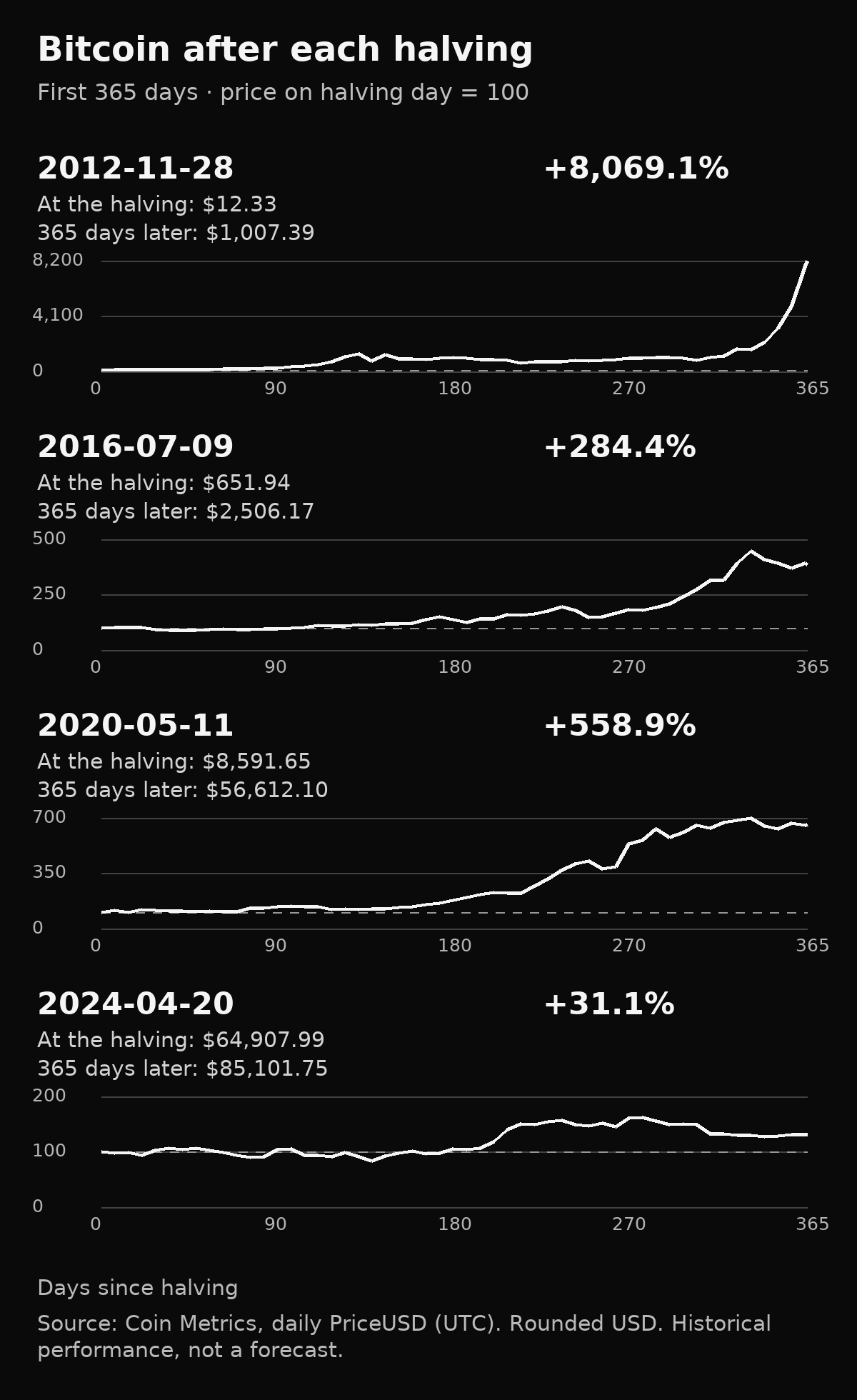
| Halving (UTC) | At the halving (USD) | 365 days later (USD) | % |
|---|---|---|---|
| 2012-11-28 | 12.33 | 1007.39 | +8069.1% |
| 2016-07-09 | 651.94 | 2506.17 | +284.4% |
| 2020-05-11 | 8591.65 | 56612.10 | +558.9% |
| 2024-04-20 | 64907.99 | 85101.75 | +31.1% |
Source: Coin Metrics, daily PriceUSD (UTC). Rounded USD. Historical performance, not a forecast.
Does the halving make Bitcoin go up?
The mechanism reduces new supply, but the price also depends on demand and those selling existing coins. If demand falls, lower issuance does not prevent a price drop. Furthermore, the halving schedule is public: investors can anticipate the change months or years before it happens.
Historical cycles coincided with changes in interest rates, global liquidity, adoption, regulation, and platform access. In 2020 there was a pandemic and extraordinary monetary policies; in 2024, spot Bitcoin ETF trading began in the United States before the halving. We cannot attribute the entire price evolution to a single mechanism.
Four events are a small sample, and the 2012 market was much less liquid than today's. Past results do not prove the next cycle will repeat the pattern, nor do they allow for a promised return. This guide explains rules and data: it is not a buy signal or a price forecast.
What happens to miners and security?
If price, fees, and competition remain unchanged, a miner receives less revenue from the subsidy after the cut. Less efficient equipment may stop being profitable. Electricity costs, hardware performance, and available capital influence who continues mining; not all miners react the same way.
Bitcoin adjusts difficulty every 2,016 blocks to maintain an average interval close to ten minutes. If some miners disconnect, the next adjustment can help those who remain. It does not guarantee a company's profitability or eliminate all risks to the network.
In the long term, as the subsidy decreases, fees become more important in mining compensation. Future sustainability depends on transaction demand, the value of Bitcoin, and mining economics. It is incorrect to claim that the halving forces the network to close or that its future security is unconditionally guaranteed.
Key takeaways to remember
The halving changes a predictable issuance rule: every 210,000 blocks, the subsidy is cut in half. It does not change your balance or require any special action in your wallet. Since April 2024, the subsidy is 3.125 BTC per block, and the next cut is expected around 2028.
To interpret a price comparison, check the currency, source, time zone, starting point, and ending period. Different choices can produce different percentages without the protocol having changed. Always separate the certainty of the halving rules from market uncertainty.
Understand how miners create blocks, how difficulty adjusts, and why subsidy and fees are distinct concepts.
How Bitcoin Mining Works