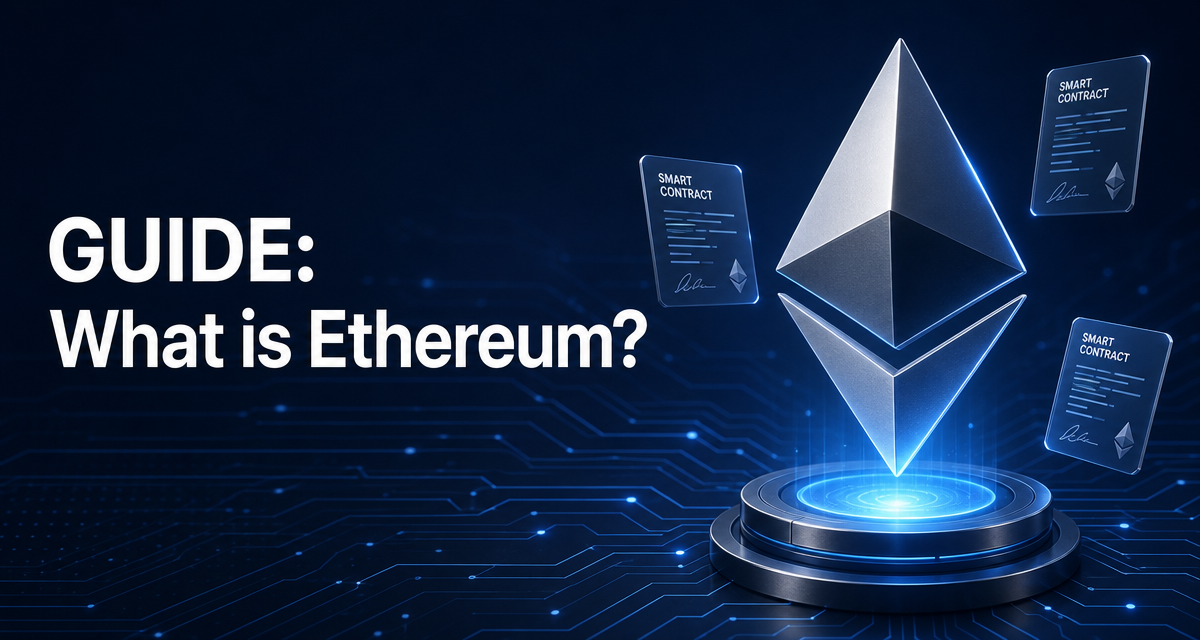
GUIDE: Ethereum, the world's second-largest cryptocurrency
Ethereum is the second-largest cryptocurrency by market capitalization and, more importantly, the platform powering most decentralized applications, stablecoins, and tokens in the market. Here, we tell you its history from the beginning, the dates that marked its development, and what ETH exactly is.
CoinGecko
The origin: a world computer, not just money
In late 2013, a nineteen-year-old programmer named Vitalik Buterin published a whitepaper with an idea different from Bitcoin's. Instead of a network designed exclusively for transferring value, he proposed a blockchain with a complete programming language: anyone could write programs that would run automatically and verifiably on thousands of computers at once.
These programs are smart contracts: code that executes when certain conditions are met, without either party being able to prevent or alter it. They can be used to create tokens, lending markets, exchanges, voting systems, or property registries.
The project was funded in 2014 with one of the first public token sales in history, and the network launched on July 30, 2015, with the Frontier version. Alongside Buterin, co-founders such as Gavin Wood, author of the technical specification, and Joseph Lubin participated.
Key dates in Ethereum's development
2013: Vitalik Buterin publishes the whitepaper. 2014: Public sale of Ether and foundation creation. 2015: Mainnet launch (Frontier) and, months later, Homestead as the first stable version.
2016: The attack on The DAO autonomous fund drains tens of millions of dollars and leads to the most controversial decision in the project's history: reversing the theft through a hard fork. This gave birth to the current chain and Ethereum Classic, which maintained the original history.
2017: Explosion of ERC-20 tokens and initial coin offerings. 2020: The beacon chain launches, the first step towards Proof of Stake, and the decentralized finance ecosystem takes off. 2021: The London upgrade introduces burning a portion of fees, reducing ether's net issuance.
September 15, 2022: The Merge replaces mining with Proof of Stake and cuts the network's energy consumption by over 99%. 2023: The Shanghai upgrade enables withdrawal of staked ether. 2024-2026: Scalability-focused upgrades drastically reduce the cost of layer-two networks, which currently concentrate most daily activity.
What is ETH and what is it used for?
Ether (ETH) is the native currency of the network. It's used to pay for gas—the cost of executing transactions and contracts—and also as collateral within much of the financial ecosystem built on top of it.
Since the transition to Proof of Stake, anyone can stake ether to help validate the network and receive rewards. Doing so independently requires 32 ETH and technical knowledge; most users do it through platforms or liquid staking protocols.
Unlike Bitcoin, ether does not have a fixed supply limit, but it does have a mechanism that burns a portion of transaction fees. When the network is heavily used, more ether is destroyed than is issued, and the supply decreases.
Ethereum vs. Bitcoin
They don't compete for the same goal. Bitcoin aims to do one thing—be scarce, censorship-resistant digital money—with maximum simplicity and stability. Ethereum aims to be a flexible platform for building applications, embracing more complexity and change.
This difference is reflected in risk. A poorly written smart contract can lose funds even if the network functions perfectly, and many of the major hacks in the sector have occurred in applications built on Ethereum, not on the chain itself.
It's also reflected in taxation and daily use: exchanging ETH for another token, receiving staking rewards, or interacting with a protocol can generate taxable events that should be recorded from day one.
How to Buy Ethereum Safely
The usual way is to open an account with a MiCA-licensed exchange, verify your identity, deposit euros via transfer, and buy ETH. Compare the real cost, not just the advertised commission: simulate a €100 purchase and a €1,000 purchase and see how much ether you receive on each platform.
If you plan to hold long-term, withdraw to your own wallet and keep the recovery phrase offline. If you're going to use decentralized applications, start with small amounts and always review the permissions you grant to each contract.
Consult our comparison of MiCA-licensed exchanges to buy ETH with transparent fees.
Buy Ethereum